Guide
How to Get a High Score in T-Rex Game — Tips & Guide (2026)
A Structured Path from 500 to 10,000+ Points
Getting a genuinely high score in the T-Rex game isn't about luck — it's about building specific skills in a logical order. Each score tier requires different techniques and a different mental approach. This guide maps the path from beginner scores to elite performance, giving you clear goals and the specific skills to reach each one.

At a glance
Quick Summary
- 01Master the Two Inputs Before Anything Else
- 02Always Look Ahead of the Dino
- 03Accept Every Run, Don't Quit Early
- 04Use Fast-Fall When It Helps
- 05Read Pterodactyls Correctly
Stage 1: Reaching 500 Points Consistently
Master the Two Inputs Before Anything Else
BeginnerBefore chasing high scores, make both jump and duck completely automatic. Spend five minutes playing while deliberately ducking every possible chance, then five more minutes focusing only on minimal hops. Players who truly own both inputs stop making control errors, which account for most deaths below 500 points.
Always Look Ahead of the Dino
BeginnerFocus your gaze approximately one-third of the way from the right edge of the screen. This keeps obstacles in your vision as early as possible. New players who watch the dino itself are always reacting too late — you need the maximum reaction window, which means looking far ahead.
Accept Every Run, Don't Quit Early
BeginnerPlayers who quit runs when they feel "unlucky" don't build skill. Every run to completion — even short ones — builds reaction time and pattern familiarity. The early hundred points of each run are calibration time; make the most of them rather than resetting impulsively.
Stage 2: From 500 to 2,000 Points
Use Fast-Fall When It Helps
IntermediateDown Arrow while airborne triggers speed drop. Use it when landing sooner is useful for the next visible obstacle, not automatically after every jump.
Read Pterodactyls Correctly
IntermediatePterodactyls become eligible at speed 8.5, roughly 450 score under nominal desktop timing. Jump the lowest y=100 bird, duck the middle y=75 bird, and run under the highest y=50 bird.
Keep Rhythm Through the 700 Trigger
IntermediateAt 700 points, current Chromium can trigger a temporary color inversion. The timer lasts 12 seconds, but collision and speed rules do not change because of the palette.
Stage 3: From 2,000 to 10,000+ Points
Read Earlier as Speed Rises
AdvancedNormal mode continues accelerating beyond 700 and reaches its source-derived cap around 1,660 score under nominal timing. Move your attention farther ahead as speed rises, then act only after classifying the obstacle.
Use a Repeatable Setup
AdvancedKeep the same keys, a comfortable hand position, and a visible foreground tab so practice runs are comparable.
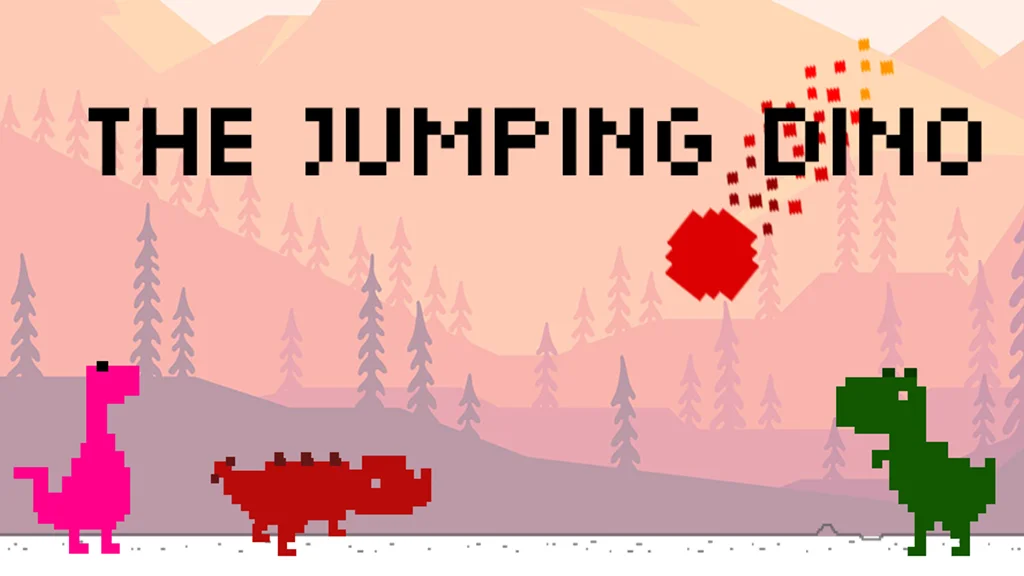
Use The Jumping Dino for Structured Practice
IntermediateThe Jumping Dino's 15 campaign levels provide explicit progression and its Infinite mode provides a separate endless format. Treat it as additional runner practice, not a calibrated equivalent of Chromium physics.